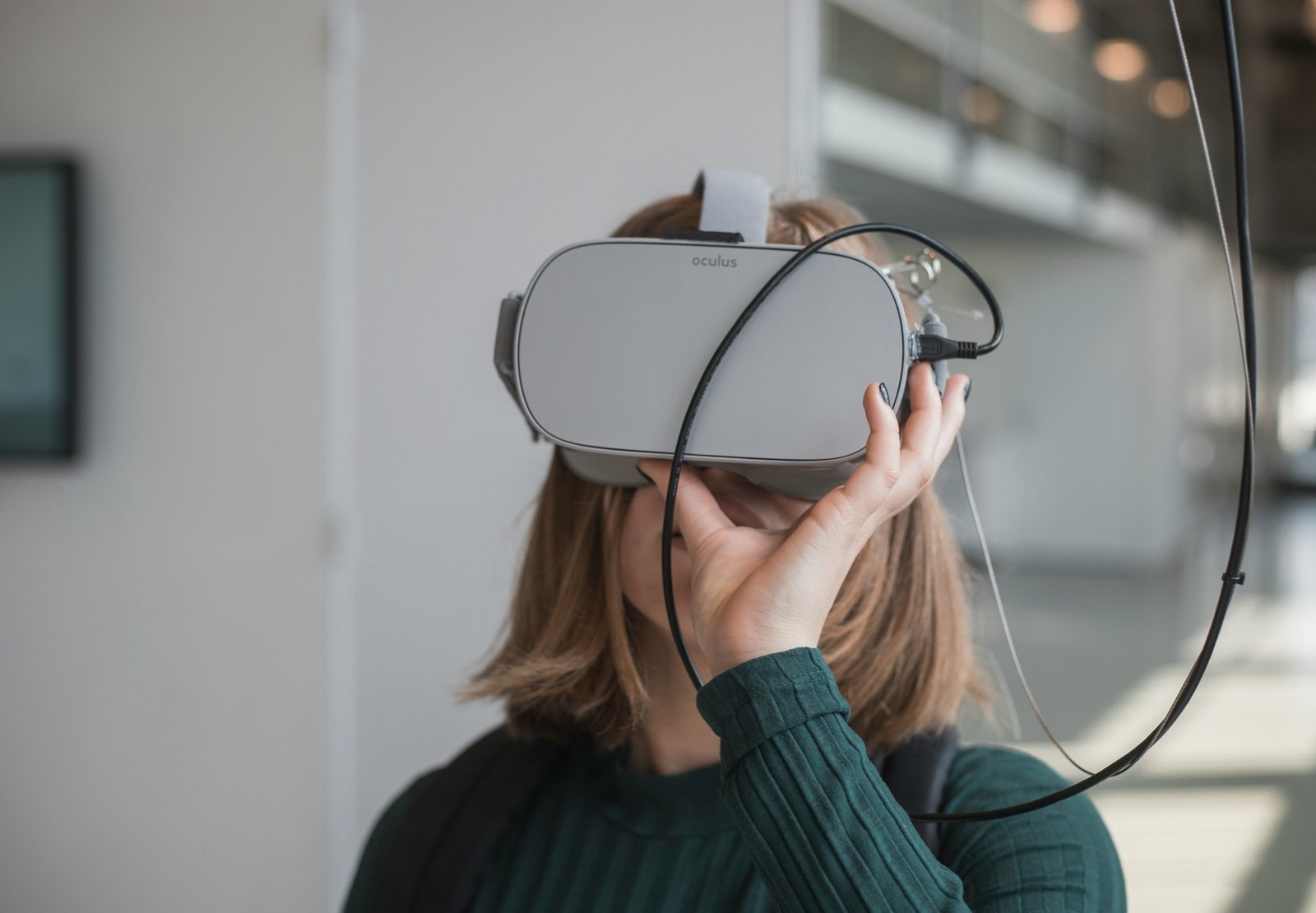
With the way business has to be conducted in our world today, innovation is vital for any corporation so that they can have quicker turnaround times with production times and be able to introduce better quality products. Two of these game-changers have been Augmented Reality (AR) and Virtual Reality (VR). Immersion with these technologies is changing the way they are used to conceptualize, build, and test products in several verticals.
Understanding AR and VR
But, first and foremost let’s try to clear the difference between AR & VR before we explore their application in product development.
AR (Augmented Reality): The integration of digital information with the user’s environment in real-time. 3. Both physical and digital elements are blended for users.
Virtual Reality (VR), is an experience taking place within a simulated and interactive 3D environment, that incorporates mainly auditory and visual feedback.
These technologies have distinct strengths in product development that cover from concept generation to the final part of manufacturing.
AR and VR in the Product Development Lifecycle
1. Concept Development and Ideation
AR and VR in product development: early-stage ideation.
Virtual Ideation: With the help of VR, remote teams can join together in a single virtual room to work on Ideas jointly thereby increasing creativity & generating ideas.
Quick Prototyping: The novel approach for designing is to project digital models on ADDITIONAL test scenes instead of physical advanced layouts.
2. Design and Engineering
AR and VR design tasksAs ideas begin to form on paper, AR & VR technologies are powerful tools for validating designs further:
Simple 3D Modeling: Designers can easily design in 3D space but that is workable only if the design tools and designs themselves are simple.
Design Reviews: Teams can execute design reviews virtually, and visualize product designs at full scale and warehousing procedures.
Ergonomics Testing: One of the benefits is that VR simulations can be used to test product ergonomics and user interactions prior production of physical prototypes.
3. Testing and Validation
Augmented and virtual reality cuts product testing in time, cost
VIRTUAL SIMULATIONS: While simulating for complex scenarios and stress tests engineers may easily identify a problem ( Virtual Reality )
Focus group testing: AR apps enable potential customers to virtually ‘place’ products in their surroundings, giving developers a better idea of how consumers would use the product once it enters production.
Training Simulations: you can train assembly line workers to make end-users for new products on usage and find potential usability glitches using VR.
4. Manufacturing and Quality Control
Value-add even in production phases Continue to view gameplay on AR/VR
Guided Assembly: AR overlays help guide employees through complicated assembly processes, reducing error rates and increasing throughput.
Quality Inspection: With AR proprietary information is overlaid onto the actual image to help quickly spot deviations from specifications during quality control.
This includes but is not limited to Remote Assistance: AR allows the experts at remote locations to assist on-site technicians in executing complex procedures or troubleshooting.
Benefits of AR and VR in Product Development
Shortened Time-to-Market: AR and VR can cut the time it takes to develop a product by allowing for rapid iterations without needing physical prototypes.
Cost Savings: Virtual prototyping and testing significantly reduce material costs, as well as the cost of physical prototypes.
Enhanced Collaboration: It helps in improving communication and collaboration amongst multi-disciplinary teams irrespective of geographical locations.
Improved Decision Making: Immersive visualizations offer more comprehensive insights for stakeholders, helping them make better decisions throughout development.
Innovation: When teams can rapidly prototype and test new ideas in virtual environments the barrier-to-entry is much lower, meaning ideation can be more creative.
Improved User Experiences: Testing in AR and VR at an early stage contributes to better products, which are more in compliance with the pattern of end-user perspectives.
Challenges and Considerations
Although the advantages are massive, there also exist challenges when introducing AR and VR in product development:
Initial Expense: AR and VR hardware as well as software, especially the most effective kinds can be expensive; therefore one must evaluate it in terms of cost vs benefits.
Teams still have to learn and get trained in the new tools and workflows
Data Management – Because you will be using highly detailed 3D models and simulations, your data management software must have robust computing capabilities.
Integrating with Existing Systems: To make optimal use of AR and VR solutions, they need to be integrated within the existing CAD, PLM, and other enterprise systems.
Risk of Over-Reliance: Striking a balance between virtual testing and real-world validation checking to produce safe quality products.
Looking Ahead
AR and VR technology is moving forward at a high pace, naturally, this field of product development will also benefit. Whether AI-powered design assistants in VR, or advanced haptic feedback in AR for instant and more realistic prototyping— the future of product development is set to be both immersive and super-efficient.
The companies who can make the best use of these two are eyeing a huge advantage over their competitors to get better products in front of consumers faster and cheaper. In the future, AR and VR in product development can go from being an advantage to a requirement as integration becomes essential for many industries going forward.
Embracing these transformative technologies will enable businesses to innovate in how they design and create while continuing to drive towards superior products that deliver above-expectation consumer experiences.